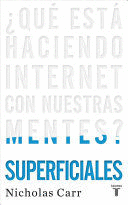

u003cbu003e¿Qué está haciendo Internet con nuestras mentes?u003c/bu003e u003cbu003eEste libro cambiará para siempre nuestro modo de entender y aprovechar las nuevas tecnologías.u003c/bu003eu003cbru003e u003cbru003e «¿Google nos vuelve estúpidos?» Nicholas Carr condensó así, en el título de un célebre artículo, uno de los debates más importantes de nuestro tiempo: mientras disfrutamos de las bondades de la Red,¿estamos sacrificando nuestra capacidad para leer y pensar con profundidad? En este libro, Carr desarrolla sus argumentos para crear el más revelador análisis de las consecuencias intelectuales y culturales de Internet publicado hasta la fecha.u003cbru003e u003cbru003e Nuestro cerebro, como demuestran las evidencias científicas e históricas, cambia en respuesta a nuestras experiencias, y la tecnología que usamos para encontrar, almacenar y compartir información puede, literalmente, alterar nuestros procesos neuronales. Además, cada tecnología de la información conlleva una ética intelectual. Así como el libro impreso servía para centrar nuestra atención, fomentando el pensamiento profundo y creativo, Internet fomenta el picoteo rápido y distraído de pequeños fragmentos de información de muchas fuentes. Su ética es una ética industrial, de la velocidad y la eficiencia.u003cbru003e u003cbru003e La Red nos está reconfigurando a su propia imagen, volviéndonos más hábiles para manejar y ojear superficialmente la información pero menos capaces de concentración, contemplación y reflexión. Este libro cambiará para siempre nuestro modo de entender y aprovechar las nuevas tecnologías.u003cbru003e u003cbru003e u003cbu003eReseñas:u003c/bu003eu003cbru003e «Absorbente y perturbador. Todos bromeamos sobre cómo Internet nos está convirtiendo, y especialmente a nuestros hijos, en cabezas de chorlito acelerados incapaces de meditaciones profundas. No es ninguna broma, insiste Carr, y a mí me ha convencido.»--John Horgan, u003ciu003eThe Wall Street Journalu003c/iu003eu003cbru003e u003cbru003e «Una réplica calmada y elocuente a aquellos que afirman que la cultura digital es inofensiva, que afirman, de hecho, que nos estamos volviendo más listos cada minuto que pasa simplemente porque podemos conectarnos a un ordenador y dejarnos llevar por un interminable carrusel de links.»--Julia Keller, u003ciu003eChicago Tribuneu003cbru003eu003c/iu003eu003cbru003e u003cbu003eENGLISH DESCRIPTIONu003cbru003eu003c/bu003eu003cbru003e u003cbu003eFinalist for the 2011 Pulitzer Prize in General Nonfiction: "Nicholas Carr has written a u003ciu003eSilent Springu003c/iu003e for the literary mind."--Michael Agger, u003ciu003eSlateu003c/iu003eu003cbru003e u003cbru003e "Is Google making us stupid?" When Nicholas Carr posed that question, in a celebrated u003ciu003eAtlantic Monthlyu003c/iu003e cover story, he tapped into a well of anxiety about how the Internet is changing us. He also crystallized one of the most important debates of our time: As we enjoy the Net''s bounties, are we sacrificing our ability to read and think deeply?u003cbru003eu003c/bu003eu003cbru003e Now, Carr expands his argument into the most compelling exploration of the Internet''s intellectual and cultural consequences yet published. As he describes how human thought has been shaped through the centuries by "tools of the mind"--from the alphabet to maps, to the printing press, the clock, and the computer--Carr interweaves a fascinating account of recent discoveries in neuroscience by such pioneers as Michael Merzenich and Eric Kandel.u003cbru003e u003cbru003e Our brains, the historical and scientific evidence reveals, change in response to our experiences. The technologies we use to find, store, and share information can literally reroute our neural pathways.u003cbru003e u003cbru003e Building on the insights of thinkers from Plato to McLuhan, Carr makes a convincing case that every information technology carries an intellectual ethic--a set of assumptions about the nature of knowledge and intelligence. He explains how the printed book served to focus our attention, promoting deep and creative thought. In stark contrast, the Internet encourages the rapid, distracted sampling of small bits of information from many sources. Its ethic is that of the industrialist, an ethic of speed and efficiency, of optimized production and consumption--and now the Net is remaking us in its own image. We are becoming ever more adept at scanning and skimming, but what we are losing is our capacity for concentration, contemplation, and reflection.u003cbru003e u003cbru003e Part intellectual history, part popular science, and part cultural criticism, u003ciu003eThe Shallowsu003c/iu003e sparkles with memorable vignettes--Friedrich Nietzsche wrestling with a typewriter, Sigmund Freud dissecting the brains of sea creatures, Nathaniel Hawthorne contemplating the thunderous approach of a steam locomotive--even as it plumbs profound questions about the state of our modern psyche. This is a book that will forever alter the way we think about media and our minds.
 2ª mano
 2ª mano
 2ª mano
 2ª mano
 2ª mano
 2ª mano